If investors have been systematically underestimating the risk of holding stocks, where did this bias come from? The financial services industry deserves some of the blame, as do individual investors.
Financial advisers are compensated based on their ability to get clients to invest primarily in equity funds instead of bond funds because higher management fees can be earned on equity funds. It is a lot easier to collect a 2% expense ratio from a stock fund earning 12% than a bond fund earning 5%. There is also a herd mentality - if you put your clients in safe but low return investments, when they hear about their neighbor's awesome returns for 2 or 3 years in a row, you are likely to be out of a job. So advisers try to stay close to the benchmark of what everyone else is doing and speak of performance in relative terms, "we outperformed the S&P 500 by 5% last year." But if the S&P lost 40%, you still lost 35%. As the saying goes, “you can’t eat relative returns,” meaning that if you depend on your portfolio for living expenses, a 35% loss may drastically reduce your standard of living. Another common fallacy: many people think that after a 35% loss, a 35% gain will get them back to break-even. In reality, you need a 54% gain the subsequent year just to break even (and if there was inflation, you still lost ground). We must pay more attention to absolute returns and capital preservation along with growth and inflation protection.
Investors are also guilty of focusing on returns rather than risk. With higher expected returns, they can afford to save less and spend more today. If you assume your investments will earn 12% compounded over the next 30 years (illustrated graphically in almost every investment advisor proposal), you hardly need to save anything at all for retirement. This fallacy was believable not only because we heard it from the "experts" but because we wanted to believe it. It is much easier to increase your 401k’s allocation to equities than to save an additional 10% of your income. I’ve heard from people close to retirement who realize they cannot save enough to afford the lifestyle they expect – so they increase their equity allocation in the hopes of doubling down and winning big. People in that situation should be taking less risk, not more. Stock returns in the 1980s and 1990s made it even easier to believe that stocks would always bounce back. Unfortunately, the power of leverage and cheap credit to inflate those returns is only now fully understood.
The bottom line: asset allocation is the single most important factor in investment returns. But investment returns are only a means to achieve an even more important objective: a comfortable retirement (or college savings, or whatever your goal may be). The most certain way to achieve your long-term financial goals comes not from investing a high percentage of your net worth in stocks, but in saving a higher percentage of your after-tax income and reducing household debt. Stocks are unquestionably an important part of any portfolio. I do not deny the benefits of diversification and its ability to improve the risk-return tradeoff. But stocks are not a low risk investment, no matter how long you hold them. They are also not a silver bullet that will allow you to save 3% of your income and guarantee a comfortable retirement just because you put 90% of your IRA in equities. “Saving” should be risk free, and “investing” should be risky. Somewhere along the way we confused the two terms.


Feb 24, 2009
The true risk of stocks for the long run (part 2)
This simple model posits that investing in stocks for 30 years is actually more risky than investing in them for only 1 year. This runs counter to most of the standard advice about investing. Yet you can clearly see that the risk of investing in stocks increases with time by looking at the price of insuring your portfolio against losses buy buying put options on the S&P 500 index. The graph below shows the how the cost of such insurance as a percentage of your portfolio increases as you increase the length of time you want protection. But are there other reasons why stocks really are a better investment for the long run?

My coin flipping model assumes that returns follow a binomial distribution. For this to be true, equity returns must follow a random walk. Although I believe they do but this is open to debate. There is some evidence that returns are not random from year to year, but are actually mean-reverting. This occurs when a stochastic process tends to return to its long-term average value. To put it another way – if stocks drop a lot over several years, eventually prices will be so low that investors start buying, and returns move back to the average. It’s a plausible theory, but the mean reversion effect is weak. You can’t earn abnormal profits by buying after the market drops one year or sell short after it rises the following year. For example, after the market has a bad (good) year, it may continue to drop (rise) for the next several years. Even if we accept mean reversion, it may take so long for returns to get back to the average that an investor can’t rely on them to prevent his portfolio from declining over a 10 or 20 year period. If those 20 years occur near your retirement, there may not be time to recover before you are forced to start drawing down your principal.
Another line of reasoning says that an investor has two types of assets in his portfolio: financial capital and human capital. Early in your career, you have a lot of human capital and little financial capital. Over time, you convert your human capital into financial capital through savings. Returns to human capital are considered risk-free. Since the intelligent investor should consider the risk of all assets in his portfolio, young people with a lot of riskless human capital can afford to take more risk with their financial capital, and shift this mix over time. My problem with this argument is that your human capital should not be viewed as a risk-free asset. Skills and education are valuable but not invulnerable from risks such as technological change or substitution by cheaper labor somewhere else in the world. Moreover, your returns to human capital are not completely independent from the overall economy. Unemployment and declines in equity prices are highly correlated, so at the time you are most likely to lose your job (or at the very least, not receive a raise or promotion), stocks are also likely to be down. A counter argument to my proposal says that if stocks prices go down, you can work more years to replenish your portfolio. However, there are many other risks to your human capital such as illness, injury, or family circumstances that could force you to leave the labor force early. I believe that economic security in retirement is just too important to assume that none of these risks will affect you.

My coin flipping model assumes that returns follow a binomial distribution. For this to be true, equity returns must follow a random walk. Although I believe they do but this is open to debate. There is some evidence that returns are not random from year to year, but are actually mean-reverting. This occurs when a stochastic process tends to return to its long-term average value. To put it another way – if stocks drop a lot over several years, eventually prices will be so low that investors start buying, and returns move back to the average. It’s a plausible theory, but the mean reversion effect is weak. You can’t earn abnormal profits by buying after the market drops one year or sell short after it rises the following year. For example, after the market has a bad (good) year, it may continue to drop (rise) for the next several years. Even if we accept mean reversion, it may take so long for returns to get back to the average that an investor can’t rely on them to prevent his portfolio from declining over a 10 or 20 year period. If those 20 years occur near your retirement, there may not be time to recover before you are forced to start drawing down your principal.
Another line of reasoning says that an investor has two types of assets in his portfolio: financial capital and human capital. Early in your career, you have a lot of human capital and little financial capital. Over time, you convert your human capital into financial capital through savings. Returns to human capital are considered risk-free. Since the intelligent investor should consider the risk of all assets in his portfolio, young people with a lot of riskless human capital can afford to take more risk with their financial capital, and shift this mix over time. My problem with this argument is that your human capital should not be viewed as a risk-free asset. Skills and education are valuable but not invulnerable from risks such as technological change or substitution by cheaper labor somewhere else in the world. Moreover, your returns to human capital are not completely independent from the overall economy. Unemployment and declines in equity prices are highly correlated, so at the time you are most likely to lose your job (or at the very least, not receive a raise or promotion), stocks are also likely to be down. A counter argument to my proposal says that if stocks prices go down, you can work more years to replenish your portfolio. However, there are many other risks to your human capital such as illness, injury, or family circumstances that could force you to leave the labor force early. I believe that economic security in retirement is just too important to assume that none of these risks will affect you.
Feb 23, 2009
The true risk of stocks for the long run (part 1)
Are retail investors taking more risk than they realize? The following discussion is directed towards individual investors who are saving for long term goals such as retirement, primarily using a buy-and-hold approach in accounts like a 401k. The conventional wisdom says that the more time until you need your principal, the more risk you can afford to take, and therefore you should invest more in stocks. What is the logic behind this? Let’s say someone offers you a $100 “investment” based on a coin flip. Heads, you earn 33%, tails, you lose 25%. So after one flip you’ll either have $133 or $75. Since each outcome is equally likely (50/50), on average your $100 investment will return $104, or 4%. That’s not too bad. Let’s imagine that each coin-flip in this example is equal to one year of investing in the stock market. Here’s what a simple payoff tree looks like:

However, you can make this investment multiple times. Every time you flip the coin, there is still a 50/50 chance of heads/tails, and the payoffs remain the same. Since the coin is random, you figure that the more times you flip it, the more likely it is that the total number of heads versus tails will even out. This is equivalent to investing over multiple years. Your financial adviser confirms your intuition and tells you that historically, the variation of stock market returns decreases as you invest over longer period of times. It’s a reasonable-sounding (but flawed) assumption that the more times you flip, the less likely you are to get a bunch of heads or tails in a row. But you believe what your financial adviser tells you, so you expect the risk of this investment to go down if you’re willing to flip it four times instead of just once. Here’s what the payoff tree looks like now:

The average ending portfolio value (probability weighted average) is now $117, which is your 4% expected return compounded 4 times. However, something strange has happened with the ending values. The dispersion between the best and worst cases has increased, from $313 to $31. You also notice that there’s a 70% chance (6% + 25% + 38%) you don’t do any better than break even, and a 31% chance (6% + 25%) that your $100 investment is worth $56 or less after 4 flips. If this money was needed to support you in retirement, would you consider these to be good odds? Is your coin-flip investment (stocks) really better than a less risky alternative investment that might guarantee you an ending value of $106 over four years but with no downside risk? This graph from the Wall Street Journal shows that anyone who started investing after 1996 would’ve been better off in a no-risk money market account than in a broad market index:

Consider the coin flip investment similar to investing in stocks. As you increase the number of investment periods above 4, the trends illustrated in this overly simplified example only continue to increase. The best case gets much better, and the worst case gets much worse. The risk of a substantial shortfall increases as you flip the coin more times. This is contrary to the traditional wisdom that a longer investment horizon reduces the risk of volatile assets. I’ve written about the myth of time diversification before, but this example clearly illustrates how the risk to your portfolio’s final value increases, rather than decreases, over time. At the end of the day, the final value is what matters – standard deviation and expected returns are great, but you can’t eat them.
My point is not that investors should avoid stocks entirely, but that they should be aware of the fact that investing for the long term does not eliminate the risk of stocks. Riskier assets have a higher expected return, but not necessarily a higher realized return. You are not guaranteed a higher return just because you took more risk. If investors are going to be compensated for taking risk, then there has to be a real risk of loss over the long term or else why would the risk premium exist? If you still don’t believe me, take a look at a graph of the Nikkei over the last 25 years:
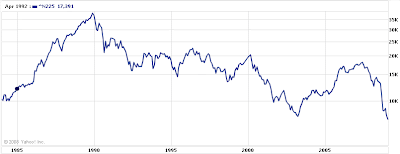
If you think I’m being overly pessimistic, or if you think the Japanese economy is sufficiently different from the US economy, then how about the returns on the S&P 500 from 1966-1982?


However, you can make this investment multiple times. Every time you flip the coin, there is still a 50/50 chance of heads/tails, and the payoffs remain the same. Since the coin is random, you figure that the more times you flip it, the more likely it is that the total number of heads versus tails will even out. This is equivalent to investing over multiple years. Your financial adviser confirms your intuition and tells you that historically, the variation of stock market returns decreases as you invest over longer period of times. It’s a reasonable-sounding (but flawed) assumption that the more times you flip, the less likely you are to get a bunch of heads or tails in a row. But you believe what your financial adviser tells you, so you expect the risk of this investment to go down if you’re willing to flip it four times instead of just once. Here’s what the payoff tree looks like now:

The average ending portfolio value (probability weighted average) is now $117, which is your 4% expected return compounded 4 times. However, something strange has happened with the ending values. The dispersion between the best and worst cases has increased, from $313 to $31. You also notice that there’s a 70% chance (6% + 25% + 38%) you don’t do any better than break even, and a 31% chance (6% + 25%) that your $100 investment is worth $56 or less after 4 flips. If this money was needed to support you in retirement, would you consider these to be good odds? Is your coin-flip investment (stocks) really better than a less risky alternative investment that might guarantee you an ending value of $106 over four years but with no downside risk? This graph from the Wall Street Journal shows that anyone who started investing after 1996 would’ve been better off in a no-risk money market account than in a broad market index:

Consider the coin flip investment similar to investing in stocks. As you increase the number of investment periods above 4, the trends illustrated in this overly simplified example only continue to increase. The best case gets much better, and the worst case gets much worse. The risk of a substantial shortfall increases as you flip the coin more times. This is contrary to the traditional wisdom that a longer investment horizon reduces the risk of volatile assets. I’ve written about the myth of time diversification before, but this example clearly illustrates how the risk to your portfolio’s final value increases, rather than decreases, over time. At the end of the day, the final value is what matters – standard deviation and expected returns are great, but you can’t eat them.
My point is not that investors should avoid stocks entirely, but that they should be aware of the fact that investing for the long term does not eliminate the risk of stocks. Riskier assets have a higher expected return, but not necessarily a higher realized return. You are not guaranteed a higher return just because you took more risk. If investors are going to be compensated for taking risk, then there has to be a real risk of loss over the long term or else why would the risk premium exist? If you still don’t believe me, take a look at a graph of the Nikkei over the last 25 years:

If you think I’m being overly pessimistic, or if you think the Japanese economy is sufficiently different from the US economy, then how about the returns on the S&P 500 from 1966-1982?

Feb 22, 2009
Pension funds and financial economics
Pension funds are experiencing a double-whammy: losses at a time when companies can least afford to fund them. This highlights the advantages of a pension asset allocation devoted entirely to fixed income. This financial economics approach does a better job of matching the duration of a pension's assets with its liabilities. Stockholders would no longer require a risk premium for the company's pension assets, decreasing the firm's cost of capital. Consequently, enterprise value would be higher and hurdle rates for capital budgeting decisions would be lower, encouraging investment and job creation. Finally, better tax efficiency can be achieved by using scarce tax-advantaged accounts to hold income generating bonds rather than equities, which are already tax efficient.
Unfortunately, misaligned incentives in the current pension regime make this change unlikely. Would any rational person claim that a dollar of stocks is worth more than a dollar of bonds? Oddly, this is the fundamental assumption of current pension accounting rules. Corporations can reduce their funding requirements by holding more equities since the expected return is higher. However, this fails to account for the added risk borne by employees (and taxpayers, via the PBGC), who are the beneficiaries of the plan. Under these rules, corporate managers are divided between doing what is best for short-term investors versus what is in the interests of long-term employees.
Unfortunately, misaligned incentives in the current pension regime make this change unlikely. Would any rational person claim that a dollar of stocks is worth more than a dollar of bonds? Oddly, this is the fundamental assumption of current pension accounting rules. Corporations can reduce their funding requirements by holding more equities since the expected return is higher. However, this fails to account for the added risk borne by employees (and taxpayers, via the PBGC), who are the beneficiaries of the plan. Under these rules, corporate managers are divided between doing what is best for short-term investors versus what is in the interests of long-term employees.
Feb 21, 2009
Internal rate of return versus time-weighted return
IRR is primarily used by investors in private, non-marketable securities while TWR is more appropriate for mutual funds that invest in liquid, public securities. Since mutual fund managers can't control the timing of cash inflows and outflows, TWR presents a more accurate view of realized returns. IRR considers the timing and magnitude of cash flows, which private equity managers have control over. More details here.
Feb 20, 2009
A bender to remember
When the price of something goes down, consumption tends to increase (all other things being equal). So what do we make of this graph from the Wall Street Journal's article on The Great Interest Rate Wave? The cost of borrowing money decreased over the last 30 years, so everyone loaded up on it. If this trend reverses, it will not be a pretty picture for investors.


Feb 19, 2009
The aftermath of financial crises
That's the title of a recent paper from the National Bureau of Economic Research. The news is not good. The authors excluded emerging markets crises from the first draft of the paper because they thought those results were too dour. Now, it no longer seems like hyperbole to include them. Here's a summary of their findings:

- On average, house prices decline 35% over 6 years
- Unemployment rises 7%
- Equity prices drop 55% over 3 years
By the second measure, we're ahead of schedule (let's hear it for the USA!). Oh, and there's an 86% increase in government debt. Good thing we balanced our budget before this mess came along. Oh wait, we've been running deficits for years? That can't be good.
They base their analysis on the "big five" crises in post-war developed markets: Spain 1977, Norway 1987, Finland, 1991, Sweden, 1991, and Japan, 1992. For good measure they include the 1997 Asian financial crisis, Columbia 1998, and Argentina 2001. Output (GDP) declines 9% from peak to trough but recovers in only 2 years, and none of the crises studied were nearly as bad as the great depression. However, previous problems were national or regional in nature. It is still unclear how the global nature of this disaster will affect the severity and time to recovery.

Feb 18, 2009

Feb 17, 2009
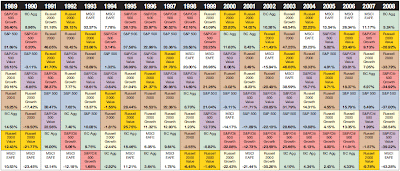
The 2008 Periodic Table of Investments
2008 may be a year that most investors would like to forget, but Callan has decided to go ahead and publish their periodic table of investment returns anyway, available here. Unquestionably, this is the worst year in the 20 years of returns shown on the chart. The best asset class, Barclay's aggregate bond index, had a lower return than any other top asset class over the years. This used to be the Lehman bond index, but they shuffled off this mortal coil. 2008's third place winner, the Russell 2000 (-33.79%), performed worse than the worst asset class in every other year.

Feb 16, 2009
Google Trends Revisited
I wrote about Google Trends before but didn't really explore the graphical option (you can also export results to Excel and manipulate the data as you see fit). A few interesting observations. Curiosity about "deflation" started to pick up at the end of last year, versus inflation which spiked earlier in the year as oil hit $147/barrel.

Searches for "cheap wedding" have been steadily increasing over the last five years, especially in 2008. Note the steady decline through the fall and spike at year end. Must be Christmas/New Years engagement surprises?

If the graph below is correct, 2008 may be the year that pawn shops replaced investment banks as sources of capital. I-banks rallied right around the time Lehman collapsed, but then continued trending down. The second image shows a geographic look at the search terms' support: Miami and Las Vegas were both bullish on pawn shops. Coincidence that these cities also have some of the most rapidly falling home values in the country.


Many terms seem to show a cyclical decrease in activity over the summer. Is this due to students being out of school and googling less?
Searches for "cheap wedding" have been steadily increasing over the last five years, especially in 2008. Note the steady decline through the fall and spike at year end. Must be Christmas/New Years engagement surprises?
If the graph below is correct, 2008 may be the year that pawn shops replaced investment banks as sources of capital. I-banks rallied right around the time Lehman collapsed, but then continued trending down. The second image shows a geographic look at the search terms' support: Miami and Las Vegas were both bullish on pawn shops. Coincidence that these cities also have some of the most rapidly falling home values in the country.
Many terms seem to show a cyclical decrease in activity over the summer. Is this due to students being out of school and googling less?
Feb 9, 2009
The Feng Shui Index
Tired of relying on fundamental analysis to figure out where the markets are going? Technical analysis isn't any better. Thankfully, an Asian investment bank, CLSA, has released their Feng Shui Index for 2009. You can download a copy here. Take note that it is based on "not much more than wind, water, a bunch of fanciful farmyard animals and frequent recourse to spirits." Although this is technically the year of the ox, they predict it will be more of a cow.
Feb 8, 2009
Endowment performance in 2008
NACUBO is the National Association of College and Business Officers. They report statistics on endowment size, performance, and asset allocation. Their 2008 endowment studies are available here and overall, they reported an annual return of -3% for 2008. However, the fiscal year for this report runs through June, not December. They also reported a further 23% decline for the first five months of the 2009 fiscal year - from July through November. Things will probably look even worse once December and January's results are included. It is striking to think that professionally managed, highly diversified portfolios, many over a billion dollars, can take such a substantial hit when the market heads down.
They also report on asset allocation by endowment size. Not surprisingly, larger endowments have greater allocations to alternative asset classes such as private equity, hedge funds, and natural resources. It will be interesting to see when the FY09 results are published if this helped or hurt the larger endowments. The average spending rate (the funds that go to support the university's operations) averaged 4.6%. If returns don't improve, I expect this will also decline in 2009, creating a budget shortfall that will leave many universities (and eventually, students) in a tough spot.
They also report on asset allocation by endowment size. Not surprisingly, larger endowments have greater allocations to alternative asset classes such as private equity, hedge funds, and natural resources. It will be interesting to see when the FY09 results are published if this helped or hurt the larger endowments. The average spending rate (the funds that go to support the university's operations) averaged 4.6%. If returns don't improve, I expect this will also decline in 2009, creating a budget shortfall that will leave many universities (and eventually, students) in a tough spot.
Jan 31, 2009
Is your city becoming a hard-money lender?
The Wall Street Journal reported this week that some cities in California are providing subsidized loans to struggling auto dealerships. Even if you believe it is the government's job to finance private enterprise, this is a terrible way to do it. Why is this such a bad idea?
- Municipal bondholders will be forced to take on more risk than they were expecting, pushing prices down and yields up. This will increase the city's cost of borrowing. Higher interest expense means higher taxes or a reduction in city services.
- Rather than diversifying its risk, the city has concentrated it even further. Since it depends on tax revenues to operate, if businesses fail then taxes will decline. After making a loan to a struggling business, it's in even more trouble if things go bad - it will lose both the tax revenue as well as the principal on the loan. So the risk of financial distress for the city has increased (is this really a good time to be taking on more risk?).
- The city is essentially engaging in interest rate arbitrage - using its strong credit rating to borrow cheap (plus taking advantage of the federal tax exemption) while lending to extremely risky businesses at below-market rates. If you found out that your city was using tax revenues to buy junk bonds, would you approve of that? This is no different. Actually, this is worse, because at least junk bonds might be fairly priced - the loans in this article are at below market rates, so the "investors" (the city's taxpayers) are not even getting a fair risk/return trade off.
- The city doesn't have the resources to properly underwrite, monitor, or enforce collections the loans like a normal bank. A bank has departments that deal with all of these issues and as a result, can provide those services at a lower cost than a city that has to develop them from the ground up.
- When things go bad, the city will face a lot of pressure to avoid calling the loan and foreclosing on the business. It creates a rat's nest of tangled political issues that will result in poor economic decisions being made.
- It encourages a "race to the bottom" among cities to offer lower tax rates to prop up uneconomical or inefficient businesses while forcing the tax burden on the successful ones.
Jan 24, 2009
S&P 500 returns and the normal distribution
One of the fundamental assumptions in modern finance's asset pricing models is that returns follow a normal (Gaussian) distribution. The histogram below shows the annual percentage returns on the S&P 500 from 1926-2008, grouped by 5% increments, overlaid with the normal distribution curve. Note the fat tail on the left that includes the two worst years, 1931 and 1937.
Until last year, many assumed that these data points could be ignored because "things were different" after WWII, so they proceeded to fill their VaR models with mean returns and standard deviations calculated post-1945. My finance textbook, published in 2006, discusses the differences between 40-year returns and 80-year returns and decides that the 40-year returns, (which exclude the 1930s) are more appropriate for our purposes. The book states that "it appears that observed fat tails are largely due to older history" and "we have more confidence that the more recent averages better estimate expected returns for the near future." Then 2008 dropped a -37% return on us. It will be interesting to see how they address this issue in the next edition.

Until last year, many assumed that these data points could be ignored because "things were different" after WWII, so they proceeded to fill their VaR models with mean returns and standard deviations calculated post-1945. My finance textbook, published in 2006, discusses the differences between 40-year returns and 80-year returns and decides that the 40-year returns, (which exclude the 1930s) are more appropriate for our purposes. The book states that "it appears that observed fat tails are largely due to older history" and "we have more confidence that the more recent averages better estimate expected returns for the near future." Then 2008 dropped a -37% return on us. It will be interesting to see how they address this issue in the next edition.

Jan 22, 2009
Businesses that will fail in 2009
The NYT has described one here. A new startup is going to assemble blog postings and print them in a free weekly paper, supported by advertising. Let me see if I can find all of the problems with this business model as compared to a traditional newspaper or a blog.
- Cost of printing and physical distribution (blogs are virtually free)
- Low responsiveness (blogs can be updated instantly)
- No fact checking or editing (a real newspaper provides those, at least)
- Environmental impact (blogs use less resources)
Basically, The Printed Blog has taken the worst parts of the newspaper business model and combined them with the worst parts of the blog model. And they're going to launch this in the worst economic environment in recent memory. Right.
Jan 21, 2009
Cartoons
Scott Adams seems to have a better understanding of basic economics than most people these days.

Meanwhile, Bill Watterson has succinctly captured the ethos of the American automakers' management:

Meanwhile, Bill Watterson has succinctly captured the ethos of the American automakers' management:
Jan 20, 2009
The winner's curse
This can occur in an auction where the bidders have incomplete information about the true value of the item they're bidding on. If the average of all the bids equals the item's true value, then whoever wins the bid must have overpaid for it, since their bid was the highest, and therefore above average. So the tendency is for the winning bidder to be the bidder with the highest misestimate of value.
Unrelated: In honor of the inauguration, here's some presidential trivia - who was the only U.S. president to successfully pay off the national debt? Andrew Jackson, in 1835. Unfortunately, the panic of 1837 (brought on by massive banking failures) and subsequent depression put an end to that, as the national debt increased ten times in the first year of the depression.
Unrelated: In honor of the inauguration, here's some presidential trivia - who was the only U.S. president to successfully pay off the national debt? Andrew Jackson, in 1835. Unfortunately, the panic of 1837 (brought on by massive banking failures) and subsequent depression put an end to that, as the national debt increased ten times in the first year of the depression.
Jan 18, 2009
Generational risk taking
A recent paper from Berkeley investigates how the risk you take as an investor may be affected by the economic environment you grew up in. Everyone has heard the stories of those who lived through the depression who refuse to trust banks. This paper finds that people who lived through strong stock market returns have an increased percentage of their wealth invested in stocks. Similarly, those who lived through times of high inflation are less likely to invest in bonds. Early experiences of macroeconomic shocks can color someone's investing philosophy for years to come, although they do show that people are still subject to recency bias, although it fades away over time. This approach supports behavioral finance, which runs counter to the traditional theory that all individuals are rational and evaluate past information (historical average returns) equally.
Going forward, will young investors over the last decade return to investing in stocks after the above average volatility experienced starting in 2000? Or will we have to wait for the next generation for the great bull market?
Going forward, will young investors over the last decade return to investing in stocks after the above average volatility experienced starting in 2000? Or will we have to wait for the next generation for the great bull market?
Jan 17, 2009
The promise of equity investing: oversold to the public?
The conventional wisdom for personal investments is that the longer you have until you need the funds, the more risk you can afford to take. A young person with many years until retirement should put a larger percentage of his asset allocation (mix of stocks, bonds, and cash) into riskier asset classes such as equities. If we examine portfolio statistics, this appears to be a reasonable suggestion - while the S&P 500 may be up or down 40% in a year, over 10 or 20 years the average annual return approaches a more reasonable number, and the standard deviation of returns (how much do returns vary each year compared to the mean) also decreases. Since the standard deviation represents risk, people believe they are taking less risk by holding for the long term.
The problem here is that an individual is concerned with his portfolio's terminal value much more than the average of his returns. That is, when you retire in 40 years, how much real purchasing power does your 401(k) provide? Unfortunately, as time increases, the dispersion of your portfolio's terminal value increases, rather than decreases. This means the range of possible values, both extremely high and extremely low, is wider. The mean (expected) value looks pretty good, and there is a lot of upside, but if you end up in the bottom 3 sigmas, you may be disappointed. See graph from John Norstad below.
My argument is not that investors should eschew stocks in favor of something else. It's that average investors may not be fully informed about the risk that they are taking, and may be misled by the apparent effectiveness of time diversification. The investment community has put the best possible spin on portfolio statistics, but may not explain the nuances to an unsophisticated investor. Now that the primary burden of providing for one's retirement has been shifted from social security and pensions to 401(k)s and Roth IRAs, it is more important than ever that people understand what is going on in those accounts.
A detailed explanation and some other arguments are available here. He gets into some other interesting considerations, such as utility theory and the options pricing model. Regarding the latter - if the risk of stocks really declined the longer you held them, put options on the S&P 500 (the right to sell the index at a guaranteed price) should cost less the further out in the future they mature. This is basically a form of portfolio insurance - you buy the option and ensure that you will receive at least a certain price for your stocks. But we observe in the marketplace that the cost of such an option increases with the time to maturity. If you tried to insure the value of your portfolio for the next 10 years this way, it would be prohibitively expensive.

The problem here is that an individual is concerned with his portfolio's terminal value much more than the average of his returns. That is, when you retire in 40 years, how much real purchasing power does your 401(k) provide? Unfortunately, as time increases, the dispersion of your portfolio's terminal value increases, rather than decreases. This means the range of possible values, both extremely high and extremely low, is wider. The mean (expected) value looks pretty good, and there is a lot of upside, but if you end up in the bottom 3 sigmas, you may be disappointed. See graph from John Norstad below.
My argument is not that investors should eschew stocks in favor of something else. It's that average investors may not be fully informed about the risk that they are taking, and may be misled by the apparent effectiveness of time diversification. The investment community has put the best possible spin on portfolio statistics, but may not explain the nuances to an unsophisticated investor. Now that the primary burden of providing for one's retirement has been shifted from social security and pensions to 401(k)s and Roth IRAs, it is more important than ever that people understand what is going on in those accounts.
A detailed explanation and some other arguments are available here. He gets into some other interesting considerations, such as utility theory and the options pricing model. Regarding the latter - if the risk of stocks really declined the longer you held them, put options on the S&P 500 (the right to sell the index at a guaranteed price) should cost less the further out in the future they mature. This is basically a form of portfolio insurance - you buy the option and ensure that you will receive at least a certain price for your stocks. But we observe in the marketplace that the cost of such an option increases with the time to maturity. If you tried to insure the value of your portfolio for the next 10 years this way, it would be prohibitively expensive.
Jan 14, 2009
Word Clouds
There's an interesting web application at Wordle, which allows you to easily create word clouds from text or a blog feed (RSS or Atom). Options include the font, colors, shape, and layout. Here's a word cloud created from a Wall Street Journal article on how banks are going to need more capital.

Jan 11, 2009
Words of the day
Antediluvian (adj.)
1. Extremely old and antiquated.
2. Occurring or belonging to the era before the Flood (as told in the Bible).
[From ANTE + Latin dīluvium, meaning flood.]
Logomachy (noun)
A battle of words.
[From the Greek logos (words) + makhe (battle).]
Terpsichorean (adj.)
Relating to dancing.
[From the Greek terpein (to delight) + khoros (dance).]
1. Extremely old and antiquated.
2. Occurring or belonging to the era before the Flood (as told in the Bible).
[From ANTE + Latin dīluvium, meaning flood.]
Logomachy (noun)
A battle of words.
[From the Greek logos (words) + makhe (battle).]
Terpsichorean (adj.)
Relating to dancing.
[From the Greek terpein (to delight) + khoros (dance).]
Jan 6, 2009
Early derivative contracts
Aristotle wrote about Thales of Miletus, a man who lived around 600 BC and was perhaps one of the first people ever to speculate on commodity prices using options. During the winter, he surmised that the olive crop would be plentiful this year, and bid on the right to use the olive presses during the summer, after the harvest came in. Since it was the off-season, there were no other bidders and he secured the call option quite cheaply. When the crop arrived as he predicted, there was great demand to make olive oil, and he was able to sell the options to the farmers for a tidy profit. This paper discusses in more detail the fair price for an olive press option, applying the Black-Scholes pricing model.
Jan 5, 2009
Refiners' stock prices and the crack spread
The crack spread is a rough measure of an oil refiner's gross profit margin. It measures the difference between the cost of inputs (crude oil) and outputs (gasoline, fuel oil, diesel, etc.). Normally this ratio is expressed as 3-2-1, where 3 barrels of crude yield 2 barrels of gasoline and one of heating oil, although other ratios are also possible. The term "crack" refers to the process of breaking the hydrocarbon molecules in crude oil through the application of either a catalyst (cat cracking) or hydrogen (hydrocracking). Another interest fact: a high complexity refinery can actually output 5-10% more material by volume than it consumes as inputs due to volumetric expansion as lighter molecules are produced.
Since the crack spread is a measure of profitability, one might expect that refiners' stock prices are highly correlated with it. The strange thing in 2008 was that refiners were much more highly correlated with the overall stock market (represented by the S&P 500) than the crack spread. The crack spread even became negative at one point in the year - why would refiners continue to operate only to lose money on every barrel they refine? The answer is that they had hedges which locked in input or output prices at levels other than the currently observed spot prices.
Since the crack spread is a measure of profitability, one might expect that refiners' stock prices are highly correlated with it. The strange thing in 2008 was that refiners were much more highly correlated with the overall stock market (represented by the S&P 500) than the crack spread. The crack spread even became negative at one point in the year - why would refiners continue to operate only to lose money on every barrel they refine? The answer is that they had hedges which locked in input or output prices at levels other than the currently observed spot prices.
Jan 4, 2009
Your state's credit rating
Where does your state fall on the credit rating scale? Interesting that the east coast has a string of AAA ratings, while the west has a cluster of states with no general obligation government bonds at all (those appear to be the states with low population densities). Also noteworthy: states can't declare bankruptcy, while cities and municipalities can. Yields on munis have certainly become more attractive, but I'd look to GO bonds over revenue bonds tied to a specific source of income (they lack the full faith and credit of the governmental entity). From an article in Fortune.

Jan 2, 2009
The 4.4% of the S&P500 that stayed in the green
Only 22 of the 500 stocks in the S&P500 finished 2008 in positive territory. Not surprisingly, we see Wal-Mart, the Dollar stores, and McDonald's on the list, plus several biotech/pharma companies. UST, which sells smokeless tobacco and wine (what a great flavor combination), also posted a gain due to its impending buyout by Altria. A few chemical companies are on the list, probably benefiting from lower oil prices. H&R block made the cut (chalk that one up to death and taxes). And of course Autozone - when the economy slows, people do more car maintenance themselves.
The oddball on this list is Pulte - the news for homebuilders only became more negative during the course of the year. However, it had already been beaten up so badly by the end of 2007 (losing 70% of its value that year) that it was able to stay mostly flat in 2008.

The oddball on this list is Pulte - the news for homebuilders only became more negative during the course of the year. However, it had already been beaten up so badly by the end of 2007 (losing 70% of its value that year) that it was able to stay mostly flat in 2008.

Jan 1, 2009
Firstlight Financial: closed for business?
Firstlight Financial was a leveraged lender started in April of 2007 by a former GE officer, Ron Carapezzi, who took a lot of GE Commercial Finance staff over to the new firm. Ron and several other employees were graduates of GE's Financial Management Program (FMP). The company provided senior debt, second lien and mezzanine debt, structured financings and equity investments. Peaking at over 60 employees, layoffs were reported in April of 2008, reducing headcount to about 15.
Recently I noticed that the website is no longer working, and there is no answer at the listed phone number. Another victim of the credit crunch?
Recently I noticed that the website is no longer working, and there is no answer at the listed phone number. Another victim of the credit crunch?
Dec 31, 2008
Home value indexes
The S&P Case-Shiller index of home values posted an annual drop of 18% (high: Phoenix -32.7%, low: Dallas -3.0%) yesterday. But what goes into an index of home prices?

- Which geographic regions are covered
- Property value weighting (do more expensive homes have a larger impact on the index)
- Are appraisal values included rather than just sales transactions
- Are houses financed with subprime mortgages and/or non-conforming loans (jumbos) included
- Should foreclosed homes sales be included, given that they may not represent a normal transaction
Here's the Wall Street Journal's look at several different home value indices from November.
Dec 30, 2008
Google Trends
This link to Google shows search terms that are experiencing a rapid rise in popularity. Sort of, if you took the first derivative of search words, which ones are increasing the fastest.
Dec 28, 2008
Christmas spirit and the number of shopping days
It's often reported that a longer shopping season (the number of days between Thanksgiving and Christmas) translates into higher retailer receipts. But does this make sense? Just because Thanksgiving falls a few days earlier doesn't mean your gift list increases. With fewer days, one might reduce their trips to the mall but make more purchases on each trip, leaving the total amount spent unchanged. But a longer shopping season does increase the opportunity for impulse purchases.

This paper from 2005 found that a longer shopping season increased per capita retail sales by $6.50 per additional day over the relevant range, and the effect is most noticeable in electronics, apparel, food, and general merchandise. The author studied the November-December shopping season and deflated results based on October sales to adjust for the strength of the overall economy at that time to arrive at excess sales. Interestingly, increased sales in the holiday season don't translate into reduced spending in January, and since the total amount of household wealth is unchanged, the deficit must come out of savings.

Dec 27, 2008
Confirmation bias in web forums
If you believe that low-cost, buy-and-hold, index investing is the way to go, read the Bogleheads forum (named for John Bogle, founder of Vanguard).
If you want to daytrade your way to happiness with Jim Cramer, checkout the Online Traders Forum.
And if you have a love for shiny things coupled with a distrust of fractional reserve banking policy, the Kitco Bullion Dealers forum is the place for you.
If you want to daytrade your way to happiness with Jim Cramer, checkout the Online Traders Forum.
And if you have a love for shiny things coupled with a distrust of fractional reserve banking policy, the Kitco Bullion Dealers forum is the place for you.
Dec 25, 2008
Dribbles
Normally when a publicly traded company wants to issue more equity, they call up their investment bankers and put together a large follow-on offering. The stock price usually declines when this is announced since analysts interpret equity issuance as a sign that management believes the stock is overpriced (rational managers buy back their equity when it's cheap, issue more then it's pricey).
The equity markets being what they are right now, some firms are turning to dribbles to issue small amounts of equity without all the fanfare associated with a follow-on offering. This avoids depressing the share price due to a rapid increase in supply, allows the firm to be a bit more squirrelly with its disclosure, and gives the firm more control over the timing of share sales since they blend in with the normal trading activity.
The equity markets being what they are right now, some firms are turning to dribbles to issue small amounts of equity without all the fanfare associated with a follow-on offering. This avoids depressing the share price due to a rapid increase in supply, allows the firm to be a bit more squirrelly with its disclosure, and gives the firm more control over the timing of share sales since they blend in with the normal trading activity.
Dec 24, 2008
Pension plans, firm risk, and the cost of capital
This Times article discusses some firms that are dealing with the impact of shrinking pension plan funds. Another one at Bloomberg mentions a $230B decline in pension plan funding just in October and November of 2008, reducing funding levels from 97 percent down to 80 percent.
Unless you are in a very countercyclical industry and/or your stock has an extremely low beta, it's likely that your pension plan returns are going to be correlated with your overall business. So right as the economy tanks, your business slows, and the value of your pension assets declines - this is what's happening right now to many firms. That's one argument against putting all your pension funds in high risk, high return equities.
Zvi Bodie published an interesting paper that explored another reason not to invest pension funds in risky assets: Do a Firm's Equity Returns Reflect the Risk of Its Pension Plan? He argues that the market beta for your stock reflects the risk implicit in your pension plan assets. Even though these funds are technically segregated, most analysts combine all assets and liabilities when looking at the firm as a whole. This makes sense, as the company is still on the hook to pay its retirees even if the pension's investments decline in value. Therefore, the observed firm beta in the market may overstate the true risk of the firm's operating assets, which would lead to a higher discount rate than is warranted for capital budgeting projects. In turn, this could lead to incorrect rejection of positive NPV projects.
Maybe they should just put all the pension funds in fixed income?
Unless you are in a very countercyclical industry and/or your stock has an extremely low beta, it's likely that your pension plan returns are going to be correlated with your overall business. So right as the economy tanks, your business slows, and the value of your pension assets declines - this is what's happening right now to many firms. That's one argument against putting all your pension funds in high risk, high return equities.
Zvi Bodie published an interesting paper that explored another reason not to invest pension funds in risky assets: Do a Firm's Equity Returns Reflect the Risk of Its Pension Plan? He argues that the market beta for your stock reflects the risk implicit in your pension plan assets. Even though these funds are technically segregated, most analysts combine all assets and liabilities when looking at the firm as a whole. This makes sense, as the company is still on the hook to pay its retirees even if the pension's investments decline in value. Therefore, the observed firm beta in the market may overstate the true risk of the firm's operating assets, which would lead to a higher discount rate than is warranted for capital budgeting projects. In turn, this could lead to incorrect rejection of positive NPV projects.
Maybe they should just put all the pension funds in fixed income?
Dec 23, 2008
The best site for buying and selling cheap MBA textbooks
You'd think that MBAs would understand better than anyone the value of a free market to set prices. Do you really think the campus bookstore, with their monopolistic, rent-seeking tendencies and overhead expenses is really going to sell you a textbook at the lowest price possible? And at the end of the semester, are they going to give you top dollar for your buyback? Unlikely.
Enter Half.com, the pure intersection of supply and demand, with an excellent selection of textbooks.
Granted, there are a few drawbacks. You don't get instant gratification, so you might not have the textbook in time for the first day of class (you overachiever!). But can't you just borrow a copy from one of your classmates? And if you decide to drop a class after you've ordered the text, you're subject to market forces when you remarket that asset.
Enter Half.com, the pure intersection of supply and demand, with an excellent selection of textbooks.
Granted, there are a few drawbacks. You don't get instant gratification, so you might not have the textbook in time for the first day of class (you overachiever!). But can't you just borrow a copy from one of your classmates? And if you decide to drop a class after you've ordered the text, you're subject to market forces when you remarket that asset.
Dec 17, 2008
The myth of the Ford Pinto
This article raises some interesting points about the much maligned Ford Pinto. Statistically, it appears that the car was no more dangerous than other cars in the same class, which all suffered from design flaws that reduced safety (though different flaws than the Pinto's behind-the-axle gas tank). The value placed upon human life by Ford was provided by a government agency seeking comments on the potential impact of new safety regulations, not developed internally. And court rulings at the time recommended that firms use economic cost-benefit analysis to determine the appropriate balance between cost and safety. While Ford deserved criticism for an unsafe design, the reality of the situation is much more complicated than the oft-repeated story would lead you to believe.
Dec 14, 2008
Hawaii: Days 7 & 8
Saturday is our last full day here. We started off at 6:30AM with the Kanaio coast & Molokini snorkeling tour with Blue Water Rafting. Despite the early morning it was totally worth it. Great lava flows along the coast as well as excellent snorkeling, especially at Molokini island. There was a little chop on the ocean so the ride was a bit rough, but if you're interested in an adventure it's not a problem. On the way back, the captain got a radio call from another tour boat that whales had been spotted, so he turned the boat around and took us back out. Saw three whales and a pod of dolphins. Dinner was excellent fish ka-bobs at Pita Paradise in Kihei. They were made with opakapaka (snapper) which I liked more than the ono we had the night before.
Sunday we checked out, did a little shopping in Wailea and then drove north. Stopped at the Iao Valley State Park to see the Iao Needle which was cool. Lunch at McDonalds was a McTeri burger - basically a burger with teryaki sauce.

Sunday we checked out, did a little shopping in Wailea and then drove north. Stopped at the Iao Valley State Park to see the Iao Needle which was cool. Lunch at McDonalds was a McTeri burger - basically a burger with teryaki sauce.
Dec 12, 2008
Hawaii: Day 6
The clouds have disappeared so we drive up to Haleakala Crater. At 10,000 feet, the air is noticeably thinner and we're above most of the clouds. Fantastic. After driving back down the mountain (43 switchbacks!) we stop at Maui Taco for lunch. Ok, they have locations in the continental US but the burrito seems more authentic here. The rest of the day: Wailea beach and the amazing saltwater infinity edge pool at the Marriott. Funnily enough, I run into one of my MBA classmates who happens to be here on vacation.

Dec 11, 2008
Hawaii: Day 5
First day in Maui is disappointing due to the weather - constant rain. I hear they're getting it worse on Oahu. Most of the fun stuff to do here is outside, normally not a problem except for times like this. We drive to the Bailey House museum which provides a nice perspective of old Hawaii. Despite the rain, we head to the Ioa Valley State Park but find that the road up the mountain has been closed due to the weather. Given the runoff coming down a nearby creek, seems sensible. Back to the resort for the afternoon and then a nice dinner at Cafe O'Lei Kihei.

Dec 10, 2008
Hawaii: Day 4
Wednesday started off a bit later than Monday and Tuesday as we started to adjust to the new time zone. We grabbed some malasadas and coffee at Leonard's Bakery. They're similar to doughnuts in that they're fried dough, but they are doughier - maybe more egg and yeast. No hole in the middle, and covered in sugar or cinnamon sugar (fillings optional). Then to the Honolulu Academy of Arts for a tour of their exhibits. 45 minute flight to Maui then check in at the Marriott Wailea Resort. Dinner time at Da Kitchen in Kihei; big portions and low prices; great fried mahi mahi.

Dec 9, 2008
Hawaii: Day 3
Another early morning wake-up took us to Cafe Kaila for breakfast where we found a nice change of pace from Waikiki. Then we drove north on the Kamehameha highway to the Dole pineapple plantation and enjoyed the tour of their garden and trainride through the pineapple fields. Continuing north, we stopped at Haleiwa beach to crash through the giant waves and watch the surfers further out. Lunch was Giovanni's shrimp truck and shaved ice from Matsumoto's. In the afternoon we headed up to the Polynesian Cultural Center in Laie. This complex is clearly one of the island's biggest tourist traps, but they overcame my skepticism and I actually enjoyed the island exhibits as well as the dinner and Luau. Worth doing once but I probably wouldn't go back. The only downside was the hour long drive from the north shore back to Waikiki in the dark.

Dec 8, 2008
Hawaii: Days 1 & 2
We landed in Honolulu on Sunday and proceeded to baggage claim and ground transportation, waiting for our Advantage rental car shuttle to arrive. We waited, and then we waited some more. Finally calling them and getting through the generic prompts, we were informed that they had filed for bankruptcy 2 days ago and closed the Honolulu location. I guess their rate really was too good to be true.
Checked into the Marriott Waikiki Resort and managed to get a nice upgrade to a 22nd floor room (Paoakalani tower) with a partial view of the ocean and Diamondhead as well. The reception desk said that their traffic is definitely down for this time of year, must be the slow economy. They wanted an obscene $25/night for parking but I found out on TripAdvisor that we could park at the Banyan for $10 and it's literally across the street. After driving around some more, found a free "Shell" parking lot next to the Waikiki Zoo - even better. The hotel also wants $13/day for internet access, but I can pick up a free wifi signal on our balcony.
Spent Sunday afternoon recovering from the 9 hour flight by walking up and down Kalakaua Avenue and checking out the beach. Dinner at Tiki's Bar and Grill in the ResortQuest Waikiki. Nice ambiance and decent food but a bit overpriced for what you get. Did not find poi to be all that great. Must be an acquired taste.
Monday, woke up at 5AM due to the jet lag and decided to climb Diamondhead before the sun came up. First, a quick breakfast at McDonald's (they offer a Polynesian platter with Spam, or a burger with teriyaki and a pineapple). Scurried down the mountain and drove to Pearl Harbor and took the ferry out to the USS Arizona memorial. A moving experience and well worth it. We arrived at 8:30AM and were able to get on the 9AM tour. Definitely a place to visit early as the wait was stretching much longer once the tour groups started to show up. Headed to Chinatown in the afternoon and it was pretty much what you'd expect. The rest of the afternoon was at the beach. Tonight, dinner at the Hula Grill Waikiki was the best meal so far. Great food, service, and ambiance. And compared to some of the offerings on Waikiki, a decent value as well.

Checked into the Marriott Waikiki Resort and managed to get a nice upgrade to a 22nd floor room (Paoakalani tower) with a partial view of the ocean and Diamondhead as well. The reception desk said that their traffic is definitely down for this time of year, must be the slow economy. They wanted an obscene $25/night for parking but I found out on TripAdvisor that we could park at the Banyan for $10 and it's literally across the street. After driving around some more, found a free "Shell" parking lot next to the Waikiki Zoo - even better. The hotel also wants $13/day for internet access, but I can pick up a free wifi signal on our balcony.
Spent Sunday afternoon recovering from the 9 hour flight by walking up and down Kalakaua Avenue and checking out the beach. Dinner at Tiki's Bar and Grill in the ResortQuest Waikiki. Nice ambiance and decent food but a bit overpriced for what you get. Did not find poi to be all that great. Must be an acquired taste.
Monday, woke up at 5AM due to the jet lag and decided to climb Diamondhead before the sun came up. First, a quick breakfast at McDonald's (they offer a Polynesian platter with Spam, or a burger with teriyaki and a pineapple). Scurried down the mountain and drove to Pearl Harbor and took the ferry out to the USS Arizona memorial. A moving experience and well worth it. We arrived at 8:30AM and were able to get on the 9AM tour. Definitely a place to visit early as the wait was stretching much longer once the tour groups started to show up. Headed to Chinatown in the afternoon and it was pretty much what you'd expect. The rest of the afternoon was at the beach. Tonight, dinner at the Hula Grill Waikiki was the best meal so far. Great food, service, and ambiance. And compared to some of the offerings on Waikiki, a decent value as well.
Dec 7, 2008
SMU Law has top bar passage rate in Texas
Southern Methodist University's Dedman School of Law had the highest bar passage rate for the July 2008 exam, according to the Dallas Morning News. Another feather in the cap for SMU!
Dec 6, 2008
Looking on the bright side
Yesterday's jobs report was quite dismal. But here are three reasons the economy is not as bad as it could be (from a comment on another blog):
- We're not in a trade war with Europe (Smoot-Hawley)
- We do NOT have a famine (Dust Bowl)
- We do not have wholesale collapse of the banking system (50% of banks failing)
You could probably argue that last point, but still.
Dec 5, 2008
Jeremy Grantham Speaks
He's not a household name like Jim Cramer but his company, GMO, does have $107B in assets under management, so the self-described "perma-bear" Jeremy Grantham probably has some idea what's going on in the financial world. He started telling investors in 2006 to avoid risk because things were going to get ugly. Jeremy's 3Q'08 newsletter is available here. I had the opportunity to hear him speak recently, along with another GMO portfolio manager, and wanted to capture some of their thoughts in a very disorganized fashion here:

- A dim view of future prospects for humankind, very Malthusian. Basically, there will be too many people and resources will not increase fast enough, so standards of living will drop.
- We're going to write off wealth equal to 1.5 times GDP ($20T) with a 60% peak-to-trough decline for the stock market.
- If you looked at the entire world's balance sheet, we had leveraged $50T of assets with $42T of debt (80% leverage!). Now those assets are only worth $30T, but the amount of debt hasn't declined and remains stranded out there. How are we going to get rid of it? Inflate it away or offload it to the government.
- 2003-2007 was one of the biggest suckers' rallies of all time.
- The ratio of median house price to median family income was more than 3-sigma above its long term average when Ben Bernanke said that the housing market has never declined. Now it's going to overcorrect on the downside. A housing bubble is much worse for the country than a stock bubble, because it's easier to get leverage and the majority of people who own houses will be affected by it.
- The UK housing market is in a similar situation, but UK banks have yet to take a single writeoff for loans there.
- Fair value for crude oil is about $75, but it will trade between $32 and $150.
- What we have seen is the result of a "risk bubble." As investors' perceived risk decreased due to low volatility, they decided to increase risk back to their tolerance level by increasing leverage.
- In 1981, debt was about 125% of US GDP. Now it is 300% of GDP. Increase credit will probably lead to more frequent credit bubbles.
- In the 1970s, the price of treasuries implied 11% inflation for 30 years. We know how that turned out. Today, the price of treasuries implies 2% inflation for 30 years. Is that any more likely?
- The efficient market camp couldn't be more wrong. Buy and hold investing is a joke. Every asset bubble over corrects by 50% below the long term trend. We're not there yet. If you had a 3-sigma increase in asset prices based on a random walk model, you'd never get a similar 3-sigma decrease directly following it on the way down. Yet this is what every bubble looks like.
- Things can get so beaten down that even on bad news, they recover. Example: June of 1932 had terrible news every month, yet the market went up 100%.
- Japan's great recession in the 1990s was remarkable because unemployment never became a big problem.
- Most interesting was his prediction in September 1998 that the S&P 500 would have a real return of -1.1% over the next ten years. It turned out to be +0.1%, but that is still pretty close. His 1998 forecast also correctly tagged emerging markets and REITs as the biggest winners over the decade. Here's his forecast going forward. He likes high quality US stocks (low volatility, low debt), emerging markets, and commodities.
His associate also spoke about some of the unintended consequences we're seeing in the fixed income markets right now.
- In 1997 when LTCM blew up, the spread between on the run and off teh run treasuries had increased from 5 bp to 15 bp. In October of 2008, that spread had widened to 100 bp. There were basically $20 bills available to be picked up by any arbitrageur.
- Earlier this year there was a rally in Fannie Mae's bonds and some assumed it was because their financial health was improving. What actually happened was that the fed started accepting FNM bonds as collateral, so traders were buying the debt at $0.80 on the dollar and then using it to borrow $0.96 from the discount window.
- AIG's first bailout was at LIBOR+800 bp, a punitive interest rate. A few weeks later when the government opened their commercial paper facility, AIG said "can we use that?" and then proceeded to pay off several billion of L+800 debt with much cheaper government backed CP. The government was arbitraged against itself.
- The federal reserve now has $3T on its balance sheet. So far, this hasn't contributed to inflation. Most of that $3T is short term. However, there is talk of the fed buying longer term assets. This presents a problem once the economy recovers, if they are stuck holding longer term assets that may have gone bad, they will not be able to easily sell them and take money out of circulation. This could lead to problems controlling inflation down the road.
Dec 4, 2008
Hedge funds: short on original ideas
A month has passed since the massive short squeeze on Volkswagon, which briefly made the company the most valuable in the world (by market cap). As hedge funds have reported results since then, it has been interesting to note that many of them were playing this same trade and were caught trying to close out their positions at the same time (they took a bath), even funds whose established strategy had nothing to do with German automaker equities. Why would
This presents a problem for an endowment or pension fund (or even a fund of funds) that diversified its investments across several HFs that are supposed to play in uncorrelated market spaces. When things go bad, they go bad across several HFs at the same time as correlation = 1.0 just when it hurts you the most. Not to mention that it seems antithetical to the original premise of HFs - that they're supposed to be hedged against risk in one position by an offsetting position somewhere else.
Will hedge funds stop telling all their friends about their trades to encourage massive piling-on?Unknown. But it's an interesting contrast to private equity shops that try to keep their deals as quiet as possible until the last possible moment, lest more bidders show up at the auction.
This presents a problem for an endowment or pension fund (or even a fund of funds) that diversified its investments across several HFs that are supposed to play in uncorrelated market spaces. When things go bad, they go bad across several HFs at the same time as correlation = 1.0 just when it hurts you the most. Not to mention that it seems antithetical to the original premise of HFs - that they're supposed to be hedged against risk in one position by an offsetting position somewhere else.
Will hedge funds stop telling all their friends about their trades to encourage massive piling-on?Unknown. But it's an interesting contrast to private equity shops that try to keep their deals as quiet as possible until the last possible moment, lest more bidders show up at the auction.
Dec 3, 2008
Volatility strikes the S&P
Using data downloaded from Yahoo Finance, I looked at the value of the S&P 500 over the last 25 years, from 12/1/1983 to 12/1/2008, and counted the number of days where the index changed by more than +/- 4.0%. Here are the results (years not listed had zero occurences):
1986 1
1987 7
1988 2
1989 1
1997 2
1998 3
2000 2
2001 4
2002 6
2008 27
Quite a jump in 2008! And 26 of those 27 moves came in the 3rd and 4th quarters of the year. This is a crude measure of volatility compared to something like the standard deviation of returns or the VIX, but certainly one that individual investors can easily identify with. And we still have a month to go...
1987 7
1988 2
1989 1
1997 2
1998 3
2000 2
2001 4
2002 6
2008 27
Quite a jump in 2008! And 26 of those 27 moves came in the 3rd and 4th quarters of the year. This is a crude measure of volatility compared to something like the standard deviation of returns or the VIX, but certainly one that individual investors can easily identify with. And we still have a month to go...
Dec 2, 2008
Microsoft pays customers $180 million to use its search engine
You're the world's largest software company, but you can't get people to start using your search engine as Google becomes more firmly entrenched every passing day. How do you get them to come to your site instead? Microsoft has decided that cold hard cash is the answer, and they have the funds to back it up. Since June, they've been pushing a cashback promotion with its Live.com product, discussed in great detail at Fatwallet.
The normal cashback program offered discounts around 2-5% for purchases made from merchants through the site and presumably they helped foot the bill for the cashback. More unusual was the 35% cashback offered on almost any eBay purchase. This led to many sellers touting the cashback in their item descriptions, since it came at no cost to them and increased the amount buyers were willing to bid. I don't see any reason why eBay would pick up the tab for this, so that leaves Microsoft writing a lot of checks. Here's a very rough estimate of how much they've spent on this promotion so far:
The normal cashback program offered discounts around 2-5% for purchases made from merchants through the site and presumably they helped foot the bill for the cashback. More unusual was the 35% cashback offered on almost any eBay purchase. This led to many sellers touting the cashback in their item descriptions, since it came at no cost to them and increased the amount buyers were willing to bid. I don't see any reason why eBay would pick up the tab for this, so that leaves Microsoft writing a lot of checks. Here's a very rough estimate of how much they've spent on this promotion so far:
- A search on eBay for "live.com" turns up over 30,000 items with an average price around $500 (items featuring the discount probably skew expensive - not much point in saving 35% on a $20 purchase)
- With an average 20% discount (it's ranged between 8% and 35% since the summer), that's $100 paid in cashback per item
- Assume items listed turn over every 3 days, over 6 months that's 60 times sales
- 60 x 30,000 x $100 = $180 million in cash paid directly to consumers
Granted, this is a back of the envelope calculation. There are certainly items that will qualify for the cashback that don't feature "live.com" in the description which would increase the amount paid. The average cashback and velocity of sales may also vary from what I've assumed. As if the legitimate users weren't charging enough cashback, I'm sure others have been gaming the system by buying items for resale (gold bullion, gift cards) or setting up fake auctions under multiple accounts.
How many companies have the resources to make almost $200MM in cash payments to entice customers to use something as ephemeral as a search engine? A bank may spend a couple hundred to acquire a new retail customer, but at least they're protected by some switching costs. Has "Helicopter Ben" taken over Microsoft's marketing department? They're is throwing money at this problem, demonstrating the seriousness of their predicament, but I don't see the long term payoff from it.
Well, it's probably still cheaper than buying Yahoo at $31/share ($44B market cap).
Dec 1, 2008
Securitization and the real estate bubble
Some researchers at the University of Chicago recently revised an interesting paper regarding The Consequences of Mortgage Credit Expansion. A few of the possible explanations for the growth in subprime mortgage lending:
- Income growth prospects: borrowers are earning more, so they can afford more credit
- House price appreciation expectations: houses are appreciating faster, so lenders are more willing to take on credit risk since the more valuable collateral reduces their loss given default
- Supply of credit growth: securitization enabled mortgage originators to sell loans to other entities, increasing their capacity to make more loans
Their study of zip code level data finds that in spite of flat or declining incomes and stagnant house prices, lending increased substantially from 2002 and 2005. Over that period, credit provided to subprime zip codes doubled and since 2006, the foreclosure rate for those same areas is three times as high as neighboring metropolitan areas. They cite securitization as the main force behind the expansion of subprime credit, a supply-based explanation. There may also be some moral hazard at work here: increased securitization is much more prevalent among subprime zip codes and default rates increase much more rapidly for loans originated in areas of high securitization.
The next question is: why did securitization increase so much? They leave that for another paper, but it might be related to technological innovations in risk management, demand from GSEs like Fannie and Freddie, or the flood of capital into the US during this time period.
Nov 28, 2008
Liar's Poker and the end of Wall Street
Michael Lewis wrote a couple of great books: Liar's Poker, which chronicled his time on Wall Street, as well as Moneyball, which covers the art of statistics & strategy in major league baseball. Recently he published an update on the current malaise affecting Wall Street, which is a very good read. Worth it just for the computer-generated picture of a supine bull in the street.

Here's a short excerpt:
The article also points out that credit quality on fixed income investments associated with consumers always strengthen in March and April. Why? Tax refunds.
Here's a short excerpt:
Eisman stuck to his sell rating on Lomas Financial, even after the company announced that investors needn’t worry about its financial condition, as it had hedged its market risk. “The single greatest line I ever wrote as an analyst,” says Eisman, “was after Lomas said they were hedged.” He recited the line from memory: “‘The Lomas Financial Corp. is a perfectly hedged financial institution: It loses money in every conceivable interest-rate environment.’ I enjoyed writing that sentence more than any sentence I ever wrote.” A few months after he’d delivered that line in his report, Lomas Financial returned to bankruptcy.
The article also points out that credit quality on fixed income investments associated with consumers always strengthen in March and April. Why? Tax refunds.
Nov 27, 2008
What are they looking for: VCs versus LBOs
Neither one is looking so hot in this environment, but nonetheless...
Venture capitalists' desired investment characteristics:
Venture capitalists' desired investment characteristics:
- The size of the potential market
- The technology (feasibility, barriers to imitation)
- The management team
On the other hand, leveraged buyout shops are looking for:
- Demonstrated profitability
- Strong and predictable cash flows
- Readily separable assets
- Strong management team
- Non-high-tech products
Nov 26, 2008
Externalities in Energy and Credit
Why would the owner of a wind farm sell electricity to the grid at negative prices? This has been occurring with some frequency on the Texas electrical system in 2008. Partly this has to do with the isolated nature of the Texas grid and ERCOT, but the explanation also involves:
- A producer of electricity might continue to produce & sell power at a price below his marginal cost of production (even at zero) if there are added costs of shutting the generator down and restarting it when spot rates increase again.
- If a producer has low marginal costs and is receiving a subsidy based on production, then they may be incentivized to keep producing ever after the price becomes negative. If the producer knows that they will get a $35/MWh production tax credit then they'll keep the wind turbines running.
I wouldn't mind a few free kwh on my next electric bill, but a policy that essentially pays people to consume electricity seems a bit counterintuitive. While we can argue about the necessity of providing subsidies for renewable energy sources, this particular example highlights the unintended consequences that can result from even a well-intentioned policy.
It is somewhat reminiscent of the reaction to the Fed's commercial paper facility. Initially only the top rated A-1 paper could be purchased under the program. Of course, this resulted in A-2 issuers being at a disadvantage in the marketplace because no one wanted to buy their paper anymore, when they could get a government guarantee for a small premium. The CP facility basically crowded out other creditworthy borrowers who couldn't afford the 500bp spread.
Nov 25, 2008
Uncommon investment structures: tontine
I spotted news of Tontine Associates, a Connecticut hedge fund that is down +65% this year. But what's a tontine? Apparently, it's an investment vehicle which combines features of a group annuity, group life insurance, and a lottery. Each investor buys a share, and the funds are then invested, which pay dividends. As the investors die, the shares are redistributed among the surviving members until the last one collects the principal. Turns out this is no longer widely used because:
- People realized they could sign children up for it early and collect dividends for much longer than expected. A similar problem has been encountered by defined-benefit pensions as average lifespans have increased substantially.
- Investors were incentivized for killing each other to bolster their own share
Nov 24, 2008
Somali Pirates and Regressions
Shipping companies are having a rough go of it. First it was the crash in the Baltic Dry Index which may have pushed rates below operating costs, let alone debt service payments. If importers can't get letters of credit and trade financing, there's going to be less demand for shipping services. Then there was the increasing risk of highly levered firms being running into technical default due to declining volumes and lower collateral values based on the secondary market for cargo ships. Just when things couldn't get any worse, Somali pirates entered the picture.
Fortunately, we have researchers who studied this issue and summarized their results in a paper: Is Maritime Piracy Random? They cross-referenced a global registry of 350,000 ships against reported acts of piracy from 1996-2005 to develop a regression indicating the likelihood of attack based on flag of registry (country) and ship type. They find that pirates are non-random and tend to prefer Asian ships, especially fully loaded chemical/product tankers because they sit lower in the water, making them easier to board.
I'm not sure this tells us what should be done about pirates, but it does give us some indication of their modus operandi. One rationale cited by a Somali pirate is that illegal overfishing off the coast has destroyed what used to be a viable source of income for many. When you have a boat and you can no longer support yourself with fishing, what else are you going to do with it? Interestingly, the Asian financial crisis of 1997 was cited as a factor behind increased piracy in the region at the time. I guess pirates are the latest countercyclical asset, along with Spam (the meat, not the email) and the 99 Cents Only Stores.
Fortunately, we have researchers who studied this issue and summarized their results in a paper: Is Maritime Piracy Random? They cross-referenced a global registry of 350,000 ships against reported acts of piracy from 1996-2005 to develop a regression indicating the likelihood of attack based on flag of registry (country) and ship type. They find that pirates are non-random and tend to prefer Asian ships, especially fully loaded chemical/product tankers because they sit lower in the water, making them easier to board.
I'm not sure this tells us what should be done about pirates, but it does give us some indication of their modus operandi. One rationale cited by a Somali pirate is that illegal overfishing off the coast has destroyed what used to be a viable source of income for many. When you have a boat and you can no longer support yourself with fishing, what else are you going to do with it? Interestingly, the Asian financial crisis of 1997 was cited as a factor behind increased piracy in the region at the time. I guess pirates are the latest countercyclical asset, along with Spam (the meat, not the email) and the 99 Cents Only Stores.
Nov 23, 2008

Nov 22, 2008
Somali Pirates and TARP
This has been making its way around the web, but was too funny to pass up:
*SOMALI PIRATES APPLY TO BECOME BANK TO ACCESS TARP
*PAULSON: TARP PIRATE EQUITY IS AN `INVESTMENT,' WILL PAY OFF
*KASHKARI SAYS `SOMALI PIRATES ARE 'FUNDAMENTALLY SOUND' '
*Moody's upgrade Somali Pirates to AAA
*HUD SAYS SOMALI DHOW FORECLOSURE PROGRAM HAD `VERY LOW' PARTICIPATION
*SOMALI PIRATES IN DISCUSSION TO ACQUIRE CITIBANK
*FED OFFICIALS: AGGRESSIVE EASING WOULD CUT SOMALI PIRATE RISK
*FED AGREED OCT. 29 TO TAKE `WHATEVER STEPS' NEEDED FOR SOMALI PIRATES
*SOMALI PIRATES APPLY TO BECOME BANK TO ACCESS TARP
*PAULSON: TARP PIRATE EQUITY IS AN `INVESTMENT,' WILL PAY OFF
*KASHKARI SAYS `SOMALI PIRATES ARE 'FUNDAMENTALLY SOUND' '
*Moody's upgrade Somali Pirates to AAA
*HUD SAYS SOMALI DHOW FORECLOSURE PROGRAM HAD `VERY LOW' PARTICIPATION
*SOMALI PIRATES IN DISCUSSION TO ACQUIRE CITIBANK
*FED OFFICIALS: AGGRESSIVE EASING WOULD CUT SOMALI PIRATE RISK
*FED AGREED OCT. 29 TO TAKE `WHATEVER STEPS' NEEDED FOR SOMALI PIRATES
Nov 21, 2008
Did short sellers deserve the blame?
Much has been made of short sellers role in pushing the price of stocks down, and while there are probably cases where one firm was unfairly targeted, do short sellers deserve all the blame they've received for stock market declines? The Bloomberg graph below shows the S&P500 index versus the monthly NYSE open short interest over the last three years. Up until September 2008, the trend is obvious, that shorts increased while the index decreased. Now that many forms of short selling have been regulated or eliminated, has the market bounced back? Unfortunately not. Even though short interest dropped by 50% in October, stocks continued their decline. This is even more disappointing when one considers that to close out a short position, the investor has to repurchase the shares, leading to an increase in net buyers as short interest drops.
Academic research shows that increasing short interest is correlated with stock price declines and poor operating performance, so shorts are well-informed and help with price discovery. Short sellers may also be good at detecting accounting manipulations. Moreover, banning shorts may not do anything to boost stock prices, and in fact could have the opposite effect if removing short sellers decreases the liquidity of the market.

Academic research shows that increasing short interest is correlated with stock price declines and poor operating performance, so shorts are well-informed and help with price discovery. Short sellers may also be good at detecting accounting manipulations. Moreover, banning shorts may not do anything to boost stock prices, and in fact could have the opposite effect if removing short sellers decreases the liquidity of the market.

Nov 20, 2008
Cost savings from plug-in hybrid
The New York Times just reported on a couple of plug-in hybrid vehicles, such as the GM Volt and the Tesla Roadster. One interesting fact is that the Tesla gets approximately 100 miles per 32 kilowatt hours (kWh). So how would your annual fuel cost vary between a 25MPG conventional gas engine and the plug-in? The chart below compares annual fuel costs for someone who drives 12,000 miles over a range of electricity and gas prices.
As of today, I'm paying $0.14/kWh for electricity and $1.75/gal for gas, so my annual costs would be $538 for the plug-in and $840 for the conventional. With $300 savings per year, it is hard to justify the price premium on a plug-in (the Tesla is over $100,000, the Volt is estimated to cost over $40,000). Of course, fuel is only one part of the total cost of ownership for a car, and plug-ins may become cheaper as the technology matures.
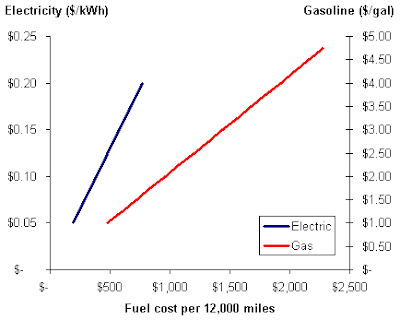
As of today, I'm paying $0.14/kWh for electricity and $1.75/gal for gas, so my annual costs would be $538 for the plug-in and $840 for the conventional. With $300 savings per year, it is hard to justify the price premium on a plug-in (the Tesla is over $100,000, the Volt is estimated to cost over $40,000). Of course, fuel is only one part of the total cost of ownership for a car, and plug-ins may become cheaper as the technology matures.

Nov 18, 2008
SMU MBA ranked 18th by BusinessWeek
The new BusinessWeek rankings are out, and Southern Methodist University (Cox) was ranked 18th in full-time MBA programs, which puts us in the same league as a lot of other very strong schools. Finally, our full-time program has received the same level of recognition as our part-time and EMBA programs! This is certainly exciting news and I hope the added attention enables us to continue attracting great students and building the school's brand. I have no doubt that SMU was the right choice for me, as it has opened so many doors over the last two years. As with most investments, the more you put into your MBA the more you will get out of it, and this program has certainly helped me maximize my ROI from graduate school.
Nov 17, 2008
Don't cash that mail-in rebate check
The credit crunch has claimed yet another unlikely victim: Continental Promotions Group (CPG) filed for chapter 11 bankruptcy on 11/14/08. Never heard of this company? You've probably done business with them before - they handled mail-in rebate fulfillment for companies like Canon, Sears, Costco, Home Depot, and many others. If you've recently received a rebate check from them, you should hold off on cashing it until you can contact the manufacturer or vendor and find out what the new rebate process is. Trying to cash the CPG check will likely be returned, resulting in no money for you plus a hefty fee. You could also run into bounced check fees if your balance drops too low after the check is returned in a few weeks.
So what does this have to do with the credit crunch? Let's look at the rebate process:
So what does this have to do with the credit crunch? Let's look at the rebate process:
- Retail customer submits rebate to CPG
- CPG receives rebate request
- CPG requests & receives payment from product manufacturer
- 8-12 weeks later: customer receives rebate check
My theory is that CPG made bad investments with the manufacturer's funds that they were supposed to be holding in escrow for those 8-12 weeks; bascially, trying to take advantage of the float. If they started chasing yield by putting those funds in supposedly safe assets that turned out to be risky (auction rate securities, Lehman commercial paper, the Reserve money market fund, etc.) then they could've easily run into a liquidity crunch. It's entirely possible that they were just poorly managed, but I doubt they would've been putting those funds into short-term treasuries when they could get a few more basis points by taking on just a little risk. Either way, they were brought down by bad working capital management.
It's unclear if this is a positive or negative sign for the remaining rebate fulfillment companies, such as Dallas based Parago. With the holiday shopping season starting to ramp up and many retailers projecting dismal sales, rebates will probably be part of the marketing promotion to get customers to shop. But retailers and manufacturers who relied on CPG may not have enough time to establish a new program before it's too late. If holiday sales are down as much as forecast, there could be further shakeouts in the fullfillment industry, since they are generally paid based on volume of rebates processed.Nov 14, 2008
The negative wealth effect
The wealth effect is an economic concept that says consumers will increase spending given a real or perceived increase in their assets. The same effect works in reverse if consumers feel they have lost value. One estimate says that GDP will decline $0.05 over the next two years for every $1.00 of wealth that is lost. If the equity markets have lost $4T and consumers perceive a similar loss in evaporated home equity (some think it could be three times as much) then that is $8T up in smoke. This translates to about $400B of disappearing GDP, which is enough to decrease GDP by 3%. I think the effect could be even more pronounced right now, given that holiday spending is about to begin. If retailers can't make it into the black this year due to lackluster sales, there could be a spill-over effect into other sectors of the economy in 2009, further worsening our economic condition.
Nov 12, 2008
Private equity deal flow & returns
Private equity firms aren't seeking 10 or 20% returns. They want to buy businesses with fully-capped (unlevered) returns around 30% and cash on cash returns (levered) in the neighborhood of 50%.
How many deals does a PE shop have to look at before they find the ones they want to fund? The deal flow funnel below gives you some idea of the process and the attrition rate.

How many deals does a PE shop have to look at before they find the ones they want to fund? The deal flow funnel below gives you some idea of the process and the attrition rate.

Nov 11, 2008
Hybrid securities
Here's a nice payoff graph that illustrates returns to a bondholder, equityholder, as well as someone who's in the middle - perhaps the purchaser of a hybrid security like a convertible bond. Note that the steep decline on the left hand side of the graph reflects the increasing risk of default as the firm value approaches zero.


Nov 10, 2008
Legitimate reasons to hedge
The best criterion for determining if risks should be hedged: does the hedge increase firm value? From an HBS paper - what are some of the imperfections that make risk management relevant?
- Costs of financial distress
- Variability of investment needs such as R&D expense
- Taxes: progressive or convex tax functions, or diminished value of tax loss carryforwards
- Transactions costs: can the firm hedge at a lower cost than an individual
- Asymmetric information flows between managers, owners, and debtholders
- Poorly diversified managers (if value added by retaining managers > cost of hedging and there is no other contractual way to reduce managers' risk)
Nov 7, 2008
Auction fees: Christie's vs. eBay
Your great aunt passes away and as the sole beneficiary in her will, you decide to auction off the estate at Christie's. Your aunt had impeccable taste, so the collection is filled with works by the Old Masters (none of that post-modern nonsense) and is worth about $100MM. What's the auction house's cut?
- 25 percent of the first $50,000
- 20 percent of the next $50,000 to $1 million
- 12 percent of the rest
At roughly $12.1MM in commission, that seems a little steep to me. Maybe you can work a better deal at a competitor - what kind of final value fees would eBay charge?
- 12 percent of the first $50.00
- 6 percent of $50.01 to $1000.00
- 2 percent of the rest
Ignoring the listing fees and some other small charges, eBay only wants $2MM - quite a bargain. Of course, you'll have to have positive feedback, and there is some question whether the hordes on eBay will appreciate your collection enough to pay top dollar.
Nov 6, 2008
Number of the day: 86 million
Barrels of oil consumed globally per day in 2008. 2009 could be the first year since 1983 where we see lower total demand.
On a somewhat related note, here's the word of the day:
Bete noire (noun)
1. An object or abstract idea that has the potential to cause great harm.
2. A flourless dark chocolate cake.
[From the French for dark beast]
On a somewhat related note, here's the word of the day:
Bete noire (noun)
1. An object or abstract idea that has the potential to cause great harm.
2. A flourless dark chocolate cake.
[From the French for dark beast]
Nov 5, 2008
Industry reading materials
How do we bridge the gap between academic research and industry? These two resources are a good start.
The Journal of Applied Corporate Finance (published quarterly)
The Financial Analysts' Journal (published bimonthly)
The Journal of Applied Corporate Finance (published quarterly)
The Financial Analysts' Journal (published bimonthly)
Nov 4, 2008
Nov 3, 2008
Crude oil in contango
Contango is the term to describe a commodities futures price that is greater than the spot price. This graph from the Wall Street Journal shows how strongly contangoed the price of crude oil has become. Perhaps the days of $60/barrel oil are not long for this world.

Nov 1, 2008
Finally done with October
I don't know if there was anyone out there who actually made money in October, but if so, my hat is off to you. People are probably thinking this story sums up the inner workings of the market...
"Once upon a time, in a village, a man appeared and announced to the villagers that he would buy monkeys for $10 each. The villagers, seeing that there were many monkeys around, went out to the forest and started catching them. The man bought thousands at $10 and, as supply started to diminish, the villagers stopped their effort. He further announced that he would now buy at $20 for a monkey. This renewed the efforts of the villagers and they started catching monkeys again. Soon the supply diminished even further and people started going back to their farms. The offer increased to $25 each, and the supply of monkeys became so small that it was an effort to even find a monkey, let alone catch it! The man now announced that he would buy monkeys at $50! However, since he had to go to the city on some business, his assistant would now buy on behalf of him. In the absence of the man, the assistant told the villagers. "Look at all these monkeys in the big cage that the man has collected. I will sell them to you at $35, and when the man returns from the city, you can sell them to him for $50 each." The villagers rounded up all their savings and bought all the monkeys. They never saw the man nor his assistant again, only monkeys everywhere! Now you have a better understanding of how Wall Street works."
"Once upon a time, in a village, a man appeared and announced to the villagers that he would buy monkeys for $10 each. The villagers, seeing that there were many monkeys around, went out to the forest and started catching them. The man bought thousands at $10 and, as supply started to diminish, the villagers stopped their effort. He further announced that he would now buy at $20 for a monkey. This renewed the efforts of the villagers and they started catching monkeys again. Soon the supply diminished even further and people started going back to their farms. The offer increased to $25 each, and the supply of monkeys became so small that it was an effort to even find a monkey, let alone catch it! The man now announced that he would buy monkeys at $50! However, since he had to go to the city on some business, his assistant would now buy on behalf of him. In the absence of the man, the assistant told the villagers. "Look at all these monkeys in the big cage that the man has collected. I will sell them to you at $35, and when the man returns from the city, you can sell them to him for $50 each." The villagers rounded up all their savings and bought all the monkeys. They never saw the man nor his assistant again, only monkeys everywhere! Now you have a better understanding of how Wall Street works."
Subscribe to:
Posts (Atom)